
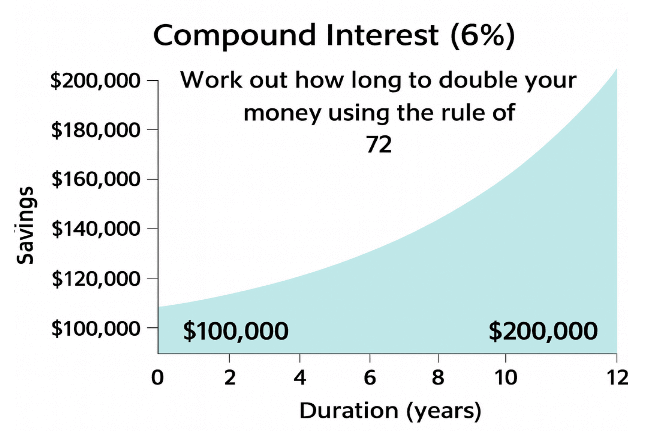
Use this Rule of 72 calculator to quickly estimate how long it takes to double money at a given interest rate per year. You can also work out the annual rate needed to double savings in a chosen number of years. This simple formula helps you understand compound growth without complex math.
Inputs for Rule of 72 Calculator
Section 1: Years to Double Money
- Input: Interest rate per year (APR)
- Output: Approximate number of years required to double money at that rate
Section 2: Rate Needed to Double Money
- Input: Number of years you want to double money
- Output: Approximate annual interest rate required to double savings in that time
Rule of 72 Calculator
How long to double your investment – work out using the simple Rule of 72.
Result: – ℹ️ This is an estimate. The Rule of 72 works best for annual compounding and rates between 6% and 10%. For exact results, use a compound interest calculator.
Result: – ℹ️ This is also an estimate. The Rule of 72 provides a quick mental shortcut, but actual compounding may differ slightly depending on frequency and rate.
Rule of 72 Assumptions
Disclaimer – Estimates Only
Results are for educational purposes and provide estimates only. Banks and providers may use different methods to calculate interest, fees, or returns. These tools do not constitute financial advice. Always confirm details with a qualified provider before making financial decisions. See our full disclaimer.
Discover More Financial Tools
Each calculator gives you one way to test money scenarios. You can also compare other tools. Use the buttons below to explore more calculators or downloadable options. This lets you look at loan, saving, and investment choices side by side.
Use the Rule of 72 to Estimate Years or Interest Rate
The formula is simple. Multiply the interest rate per year by the number of years. The result is about 72. Rearranging gives two options. Years to double money equal 72 divided by the interest rate. Interest rate required equals 72 divided by the number of years. For example, at 6% per year, 72 ÷ 6 shows that money doubles in about 12 years. As a result, you can see the power of compounding without complex math.
For a deeper explanation of compound interest, see our Financial Dictionary.
Examples: Estimate How Long It Takes to Double Savings
Examples: How Long to Double Money
Suppose your savings earn 8% annually. Divide 72 by 8. The result is 9 years. At 12%, the same calculation shows doubling in 6 years. At 4%, it takes about 18 years. These examples show how higher rates shorten the time, while lower rates extend it. The Rule of 72 makes these comparisons easy to understand and quick to calculate.
You can also explore more savings strategies in our Budgeting and Saving hub.
Practical Ways to Estimate Growth
The Rule of 72 applies to more than investments. It can estimate how inflation reduces purchasing power. For example, at 3% inflation, prices double in about 24 years. It can also show how debt grows when interest compounds. At 18% on a credit card, debt doubles in about 4 years if unpaid. These examples highlight how compounding can work for you or against you.
For broader context, see OECD resources on financial literacy.
Alternative Formulas for Doubling Money
There are other formulas. The Rule of 69.3 works better for continuous compounding. You can also adjust 72 slightly for rates outside the 6% to 10% range. Add one to 72 for every three points above 8%. Subtract one for every three points below 8%. For example, at 14% debt, using 74 gives a closer estimate of doubling. These adjustments improve accuracy while keeping the math simple.
Remember: It Is Only an Estimate
The Rule of 72 is a guide, not an exact calculation. It helps you understand growth quickly. For precise results, use a compound interest calculator or spreadsheet. Still, the rule remains valuable because it is easy to apply and remember. It gives you a fast way to see how compounding affects savings, investments, inflation, or debt.
FAQ: Rule of 72 Calculator
No. The Rule of 72 is only an estimate. For example, it works best with annual compounding and interest rates between 6% and 10%. For precise results, you should use a compound interest calculator or spreadsheet.
Yes. The same formula applies to inflation. For example, at 3% inflation, prices double in about 24 years. As a result, you can see how inflation reduces purchasing power over time.
Debt also compounds. At 18% interest, credit card balances double in about 4 years if unpaid. Therefore, the Rule of 72 helps you understand how quickly debt can grow, not just savings.
Yes. The Rule of 69.3 works better for continuous compounding. In addition, you can adjust 72 slightly for rates outside the 6% to 10% range. For example, at 14%, using 74 gives a closer estimate of doubling.
It is quick, simple, and easy to remember. For example, you can calculate doubling time mentally without complex math. As a result, it is a practical tool for learning how compounding affects savings, investments, inflation, or debt.
Recent Articles on Growing Your Savings
-
Budgeting and Saving Explained
Budgeting and saving give you a clear view of your money. They also help you plan for both today and the future.
-
Einstein and Buffett on Compound Interest
Compound interest has been called the eighth wonder of the world. Albert Einstein’s famous quote highlights its power, and Warren Buffett’s investing strategy shows how it builds…
-
Smart Places to Keep Your Hard Earned Savings
When you think about the best places to put your savings, it helps to start with a clear definition. Savings are the part of your income that…
-
Master Your Budget – Easy Steps – Budgeting & Savings Guide
Budgeting and saving are the foundation of every strong financial plan. Budgeting does not need to be complex. Instead, the key is to build a system you…
-
10 Easy Ways to Save Money – Start Now. Every Dollar Counts.
You can save money without changing your lifestyle and often improving it. Most easy ways to save money are so simple you don’t even notice them. Small…