
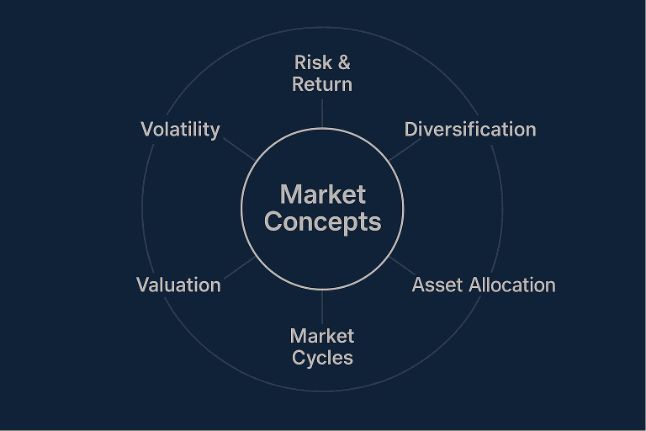
The market concepts section introduces the key ideas that explain how financial markets work. These ideas include risk and return, diversification, asset allocation, market cycles, valuation, and volatility. Together, they help you move from basic knowledge to a deeper understanding of how markets behave over time.
These concepts also support many other guides on MoneyOpes. They form the foundation for topics such as stocks, bonds, ETFs, managed funds, real estate, and alternative investments like commodities, options, and derivatives. If you are new to investing, you can begin with our beginner guide, How to Start Investing in Easy Steps. After that, explore the topics below.
Topics Covered
This section covers the core ideas that influence investment decisions across different asset types:
- How Financial Markets Work A simple overview of buyers, sellers, prices, and what drives market movements.
- Risk vs Return The trade off at the heart of every investment decision.
- Diversification and Risk How spreading investments helps manage uncertainty.
- Asset Allocation How investors divide money across asset classes to balance growth and stability.
- Market Cycle Phases Why markets move through expansion and contraction.
- Valuation Basics (coming soon) How investors assess whether an investment is priced fairly.
- Volatility and Market Fluctuations (coming soon) What causes short term ups and downs in markets.
Recent Articles on Market Concepts
-

Market Cycle Phases: How Markets Rise, Peak, Fall, and Recover
Markets move in patterns that repeat over time. These patterns…
-

Asset Allocation: How to Build a Balanced Investment Mix
Asset allocation is the way you divide your money across…
-

How Diversification Reduces Risk in Investing
Diversification helps investors manage uncertainty by spreading exposure across different…
-

Risk vs Return: Understanding the Trade Off in Investing
Understanding risk vs return is one of the first steps…

Explore More Investing Resources And Tools
Use calculators and downloadable tools, such as our ratio analysis spreadsheet to apply what you learn.
More About Our Market Concepts Topics and Resources
Understanding market concepts gives you a clearer view of how different investments behave. These ideas appear across many areas of personal finance and investing. Therefore, this section brings them together in one place. Below, you will find guides, tools, and related topics that help you apply these concepts in real situations.
How Market Concepts Connect to Real Investing Decisions
- Risk and return influence how investors choose between savings accounts, bonds, and growth focused investments like stocks and real estate.
- Diversification helps reduce the impact of market swings by spreading investments across sectors, regions, and asset types.
- Asset allocation shapes long term outcomes by balancing stability and growth.
- Market cycles explain why prices rise and fall over time. Moreover, why long term investors stay focused on trends rather than short term noise.
- Valuation and volatility help investors understand whether an investment is fairly priced. In addition, how much its price may move.
These concepts appear throughout our investing guides, from beginner topics to more advanced areas like ETFs, bonds, and alternative assets.
Related Topics and Resources on MoneyOpes
These guides build on the ideas introduced in Market Concepts:
- Investing Basics — A beginner friendly overview of how investing works.
- Investing in Stocks — How companies raise money, how stock prices move, and what influences returns.
- Bonds and Fixed Income (coming soon) — How governments and companies borrow money, and how interest rates affect bond prices.
- ETFs and Managed Funds (coming soon) — How pooled investments help diversify your portfolio.
- Real Estate Investing (coming soon) — Property, REITs, and long term wealth building.
- Alternative Investments (coming soon) — Commodities, gold, options, and other non traditional assets.
Each topic connects back to the core ideas in this section. Therefore, helping you build a stronger understanding of how markets work.
Market Concepts – Tools to Download and Online Calculators
Market Concepts – Recent and Most Read Articles and Guides
Disclaimer – Educational Use Only
Content on MoneyOpes.com is for informational and educational purposes only. It does not constitute financial, legal, or professional advice. Your financial situation is unique, and outcomes may differ. Past performance is not a guarantee of future results. MoneyOpes.com adheres to strict editorial integrity standards, and to the best of our knowledge, all content is accurate as of the date posted. See our full disclaimer.