
Estimated reading time: 17 minutes
Diversification helps investors manage uncertainty by spreading exposure across different investments instead of depending on a single one to carry all the risk. This approach reduces the impact of any one investment performing poorly and creates a steadier path toward long term goals. Therefore, as markets rise and fall, a diversified mix can soften the swings and make the overall experience more predictable. This article explains how diversification reduces risk, why diversification matters, and how simple diversification strategies can support a more balanced portfolio.
Quick Navigation
- What Diversification Means in Investing
- How Diversification Reduces Risk
- Types of Diversification
- Why Diversification Matters for Long Term Investors
- Simple Diversification Strategies
- Examples of a Diversified Portfolio
- Common Diversification Mistakes To Avoid
- How To Review And Adjust Your Portfolio Over Time
- Glossary: Diversification
- Bringing It All Together
- FAQ How Diversification Reduces Risk in Investing
- Recent Articles and Guides on Market Concepts Articles
- Latest Free Market Concepts Tools You Can Download
- Online Calculators and Other Free Tools You Can Download
What Diversification Means in Investing
Diversification means spreading exposure across different types of investments so no single holding can shape your entire outcome. Investors use it to avoid concentration risk and to build a mix where assets respond differently to the same event. As a result, when one investment drops, another may hold steady or rise, helping offset the loss. The U.S. SEC describes this idea with the familiar phrase “don’t put all your eggs in one basket,” a reminder that combining different investments can reduce the effect of any single setback. [1] This is why diversification matters for anyone building a long term portfolio. However, diversification cannot remove risk or guarantee gains, but it lowers the chance that one poor performer will derail your progress and sets the foundation for how diversification reduces risk throughout the rest of the article.
How Diversification Reduces Risk
Diversification reduces risk because it spreads exposure across many investments. Therefore, this approach stops any single holding from shaping your entire outcome. It works at two levels. First, you spread your money across different asset categories such as shares, bonds, and cash equivalents. These assets respond to economic conditions in different ways. As a result, a fall in one area may be balanced by stability or gains in another. This mix creates a smoother experience and shows how diversification reduces risk in practice.
Second, you diversify within each asset category. The SEC notes that investors benefit when they hold a range of companies and industry sectors because these groups do not move in the same way at the same time. [2] A portfolio with only a few individual shares carries more concentration risk. A broader mix reduces the impact of any single setback. Mutual funds and index funds help with this because they hold many investments at once. However, funds that focus on a single sector do not provide full diversification. Therefore, you need to invest in additional funds from other sectors or asset categories to achieve a balanced mix.
Diversification also helps when unexpected events occur. For instance, a sudden drop in one investment becomes less damaging when it represents only a small part of a wider mix. This steadier pattern supports long term decision making and reduces the pressure to react to short term market swings. In addition, it shows why diversification matters for investors who want a more stable path toward their goals. Later sections explore simple diversification strategies that apply these ideas in a clear and practical way.
Types of Diversification
Diversification works in several ways, and each type adds another layer of stability to your portfolio. These approaches build on each other and help explain why diversification matters for long term investing. In addition, they create the foundation you need to apply simple diversification strategies, discussed later in the article.
Across Asset Categories
Investors begin by spreading exposure across major asset categories such as shares, bonds, and cash equivalents. These assets respond to economic conditions in different ways. Shares may rise during periods of growth. While, bonds may hold steady when growth slows. Cash equivalents may offer stability during uncertain times. As a result, this mix reduces the chance that one broad category will shape your entire outcome.
Within Each Asset Category
Diversification continues inside each category. Shares from different companies, sectors, and regions do not move in the same way at the same time. A portfolio with only a few individual shares carries more concentration risk. Whereas, a broader mix reduces the impact of any single setback. Funds that focus on one sector also do not provide full diversification. As a result, you need to invest in additional funds from other sectors or asset categories to achieve a balanced mix. This step also shows how diversification reduces risk.
Across Sectors And Industries
Companies in different industries face different risks. Technology companies respond to innovation cycles. Consumer goods companies respond to spending patterns. Energy companies respond to commodity prices. Therefore, when you spread exposure across sectors, you reduce the effect of a downturn in any one industry. This approach adds another layer of stability to your portfolio.
Across Regions
Markets in different parts of the world move for different reasons. These include, local economic conditions, currency movements, and political events which all play a role. Therefore, when you add international exposure, you reduce the impact of events that affect only one country or region. In addition, this step also opens the door to more investment choices around the world.
Across Time
Investing regularly over time creates another form of diversification. To clarify, markets rise and fall, and regular contributions help smooth the price you pay for investments. As a result, this approach reduces the pressure to choose the perfect moment to invest and supports steadier long term progress.
Why Diversification Matters for Long Term Investors
Diversification matters because it helps your portfolio stay more stable when markets rise and fall. Different assets respond to economic conditions in different ways, so a broader mix reduces the chance that one setback will shape your entire outcome. Therefore, spreading exposure with simple diversification strategies investing your money across asset classes and across different options within each class. [3]
- Helps manage uncertainty — Markets move for many reasons, and no one can predict every shift. Therefore, when you hold a broader mix, you reduce the impact of events that affect only one company, sector, or region. This wider spread gives you more stability as conditions change.
- Reduces emotional reactions to market swings — Concentrated portfolios rise and fall sharply. However, a diversified mix softens these movements, so you feel less pressure to react quickly or change direction during short term swings.
- Supports long term thinking — Diversification encourages you to focus on your overall progress rather than the performance of one investment. As a result, this shift in focus helps you stay committed to long term goals even when markets feel unsettled.
- Creates a smoother investment experience — A diversified portfolio cannot remove risk, but it reduces the chance that one poor performer will dominate your results. Therefore, this smoother pattern makes it easier to stay invested and follow your plan.
Simple Diversification Strategies
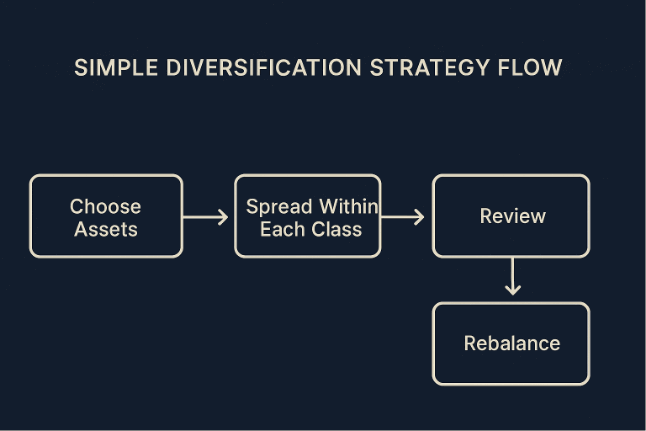
Straightforward steps can help you build a balanced mix that spreads risk and supports long term progress. Speading your exposure, with simple diversification strategies to invest your money across asset classes, within each asset class, and even across different fund managers or product issuers. [3] These ideas work together to create a clear and manageable approach.
- Use broad market index funds — These funds hold many companies across sectors and industries. Therefore, they give you instant diversification and reduce the impact of any single company on your results.
- Combine growth and defensive assets — Shares provide growth. Whereas, bonds and cash equivalents provide stability. When you combine them, you balance risk and return as markets shift.
- Add international exposure — Markets around the world move for different reasons. International funds give you access to companies and industries outside your home market. As a result, this step reduces the effect of events in any one region and expands your investment choices.
- Include real estate — Real estate often moves differently from shares and bonds. Real estate investment trusts give you access to property markets without buying property directly. Therefore, this adds another source of returns and spreads risk across more parts of the economy.
- Avoid concentration in one company or sector — Holding too much in one area increases risk. For this reason, spreading your money across more areas limits how much any single loss can affect your total portfolio.
- Keep the approach simple and manageable — A clear and consistent strategy often works better than a complex one. As a result, simple steps help you stay focused and avoid unnecessary changes as markets move.
Examples of a Diversified Portfolio
A diversified portfolio spreads your money across different assets so no single loss has too much influence on your long term results. These examples show how diversification reduces risk and why diversification matters for investors who want steadier progress over time. Each example reflects common portfolio structures discussed by Nasdaq [4] and fits naturally with the simple diversification strategies outlined earlier.
1. 60/40 Portfolio
A 60/40 portfolio places 60% in shares and 40% in bonds. This mix aims to capture long‑term growth from shares while using bonds to steady the portfolio when markets fall. In addition, investors often spread the share portion across large‑cap, mid‑cap and small‑cap companies in different sectors to avoid concentration risk. The bond portion may include government, corporate and municipal bonds. [4] This balanced structure shows how diversification reduces risk by combining growth and stability.
2. Permanent Portfolio
The permanent portfolio spreads money evenly across shares, bonds, gold and cash. Each asset responds differently to economic conditions. Specifically, shares support growth, bonds add stability, gold protects against inflation and currency changes, and cash provides safety during downturns. [4] As a result, because these assets move for different reasons, at least one part of the portfolio usually holds up when others struggle. This structure highlights why diversification matters when markets shift.
3. Dividend Portfolio
A dividend portfolio focuses on companies that pay regular dividends. Therefore, investors usually choose businesses with a long record of stable earnings and consistent dividend payments. For example, common sectors include utilities, consumer staples and financial services. [4] In addition, diversifying across several industries reduces the risk of relying on one type of company for income. This approach appeals to investors who want steady income alongside long term growth and shows how diversification reduces risk when dividend cuts occur in one sector.
4. All Weather Portfolio
The all weather portfolio aims to perform reasonably well in many economic environments. It typically includes shares, long term bonds, intermediate term bonds, gold and commodities in specific proportions. [4] Therefore, shares support growth, bonds help during slower periods, and gold and commodities offer protection when inflation rises. This mix spreads risk across assets that respond differently to interest rates, inflation and economic cycles, reinforcing why diversification matters for long term investors.
5. Large‑Cap Blue‑Chip Portfolio
A large cap blue chip portfolio invests in well established companies with strong earnings, reliable dividends and a long record of stability. These companies often operate across major sectors such as technology, health care, consumer goods and finance. [4] Diversifying across sectors reduces the impact of a downturn in any one area. Therefore, this type of portfolio offers lower volatility and steady long‑term growth. It aligns with simple diversification strategies that spread risk across different parts of the market.
Common Diversification Mistakes To Avoid
Diversification works best when your portfolio stays balanced, simple and tied to clear goals. However, mistakes often build up slowly. Therefore, spotting them early helps you act before they hurt returns. Below are common errors and practical steps to reduce their impact. They also show how diversification reduces risk and point to simple diversification strategies you can use.
Overconcentrating In One Company Or Sector

Portfolios often drift toward recent winners. As a result, you may hold too much of one company or industry. As a result, when that area falls, your whole portfolio can drop sharply. Therefore, spread investments across sectors and regions to limit that single point of failure. Also, review holdings regularly to catch drift early.
Relying Too Much On One Asset Class
Some investors hold mostly shares for growth. While, others hold mostly cash for safety. Either choice reduces the benefit of diversification. Shares, bonds, real estate and commodities react differently to economic changes. Therefore, combine them to smooth returns and lower volatility over time.
Chasing Recent Performance
Strong short term returns can tempt you to pile into the hottest asset. This habit often leads to buying high and selling low. Instead, stick to an allocation that matches your goals and risk level. Consistent diversification supports steady progress rather than quick moves.
Overlooking Fees And Product Differences
Two funds can look the same but charge very different fees or track different indexes. Higher costs eat into returns and can undo diversification benefits. Therefore, check fees and index construction before you add a product. Also, compare overlap to avoid duplicate exposure.
Forgetting To Rebalance
Markets change your allocation without warning. Without rebalancing, your portfolio can become riskier than you planned. Therefore, rebalance periodically to restore your target mix. This keeps your diversification strategy aligned with your goals as conditions change.
Holding Too Many Overlapping Products
More funds do not always mean more diversification. Many broad funds hold the same companies. As a result, that overlap adds complexity without adding real variety. To clarify, you can choose a few low cost, well chosen funds for clearer exposure and easier management.
How To Review And Adjust Your Portfolio Over Time
A regular review helps you keep your portfolio aligned with your goals. Markets move at different speeds, and your mix can drift without warning. As you review your portfolio, you also see how diversification reduces risk and how simple diversification strategies support steadier long term results.
Setting a Review Schedule
A clear schedule keeps your decisions calm and consistent. As a result, many investors review their portfolio every six or twelve months. This rhythm helps you focus on real trends rather than short swings. In addition, it reduces the urge to react to daily market moves.
Checking Your Current Allocation
Your first step is to compare your current mix with your target mix. Shares, bonds, real estate and commodities often move in different ways. Because of this, your allocation can drift over time. A quick check shows whether your portfolio still reflects your plan.
- Shares — Review exposure across regions and sectors.
- Bonds — Look at the balance between short and long maturities.
- Real estate and commodities — Confirm they still play the role you expect.
This step helps you see whether your diversification remains balanced.
Rebalancing When Allocations Drift

Rebalancing brings your portfolio back to your original asset allocation mix. [5] Over time, some investments grow faster than others. As this happens, your portfolio can move out of alignment with your goals. Therefore, rebalancing prevents one asset category from becoming too large and restores a comfortable level of risk.
For example, if you planned for shares to make up 60 percent of your portfolio but they now make up 80 percent, you can sell some shares or add more to under‑weighted categories to restore balance. [5]
You can rebalance in three main ways:
- Sell investments from over weighted categories and use the proceeds to buy under weighted ones.
- Buy new investments in under weighted categories.
- Adjust ongoing contributions so more money flows into under weighted areas. [5]
This process also reinforces how diversification reduces risk, because it trims areas that grew too fast and strengthens areas that fell behind.
Revisiting Your Goals and Time Frame
Your goals can change as your life changes. A new job, a move or a shift in savings habits can all affect your plan. When you revisit your goals, you can adjust your allocation to match your new direction. In addition, this step also helps you choose simple diversification strategies that fit your current needs.
Reviewing Individual Products
Funds that looked suitable last year may not fit as well today. Fees can change. Indexes can update. New products can overlap with what you already hold. Therefore, reviewing each product helps you avoid duplication and keeps your portfolio easy to manage.
Adjusting Contributions
Small changes to your regular contributions can keep your mix on track. Hence, when one part of your portfolio falls behind, you can direct new money there. This method supports rebalancing without selling existing holdings and keeps your long-term plan moving forward.
Staying Focused on Long Term Progress
Short term noise can distract you. A steady review process helps you stay focused on long term progress. In addition, rebalancing also encourages a “buy low, sell high” approach, because it shifts money from recent winners to areas that have lagged>. [5]
Glossary: Diversification
- Asset Allocation
- Asset allocation is the way you divide your portfolio across shares, bonds, real estate and other assets. This mix shapes your risk level and your long term results.
- Concentration Risk
- Concentration risk appears when too much of your portfolio sits in one company, one sector or one asset class. A broader mix reduces this risk and keeps your results more stable.
- Correlation
- Correlation shows how two investments move in relation to each other. Lower correlation strengthens diversification because gains in one area can offset losses in another.
- Diversification
- Diversification means spreading your money across different types of investments. This reduces the impact of any single loss and helps your portfolio stay steadier over time.
- Exposure
- Exposure shows how much of your portfolio sits in a specific asset, sector or region. Clear exposure helps you see whether your mix is balanced or drifting.
- Risk Tolerance
- Risk tolerance reflects how much movement you can accept in your portfolio without feeling pressured to change your plan. It depends on your goals, your time frame and your comfort with short term swings.
Bringing It All Together
How These Steps Fit Together
A clear diversification plan helps your portfolio stay balanced, flexible and aligned with your goals. Each part of this post builds toward that idea. Therefore, as you combine these steps, you create a mix that manages risk, supports steady progress and adapts as your life changes. This also connects to the idea of risk and return, which shapes how much movement you can accept in your portfolio.
How Diversification Strengthens Your Portfolio
Diversification begins when you spread your money across different asset classes. Shares, bonds, real estate and commodities respond to economic conditions in different ways. Therefore, when you combine them, you reduce the impact of any single setback and create a mix that can handle a wide range of market environments. This foundation also supports simple diversification strategies that keep your portfolio steady over time.
Your next step involves broadening your exposure within each asset class. First, spread your share holdings across regions and sectors. Next, balance your bond exposure across different maturities. Then, add real estate or commodities when they fit your goals. Each choice strengthens your portfolio and reduces the chance that one part of the market will dominate your results.
How Rebalancing and Routine Keep You on Track
As you build your mix, you also avoid common mistakes. Therefore reducing the risk of overconcentration by checking where your money sits. In addition, you avoid chasing recent performance by sticking to your plan. Unnecessary costs are also limited by reviewing fees and product differences. You should also keep your portfolio simple by avoiding overlapping products. Therefore, these habits help you stay focused on long term progress rather than short term noise.
Your review process brings everything together. Markets move at different speeds, so your allocation can drift. Therefore, rebalancing brings your portfolio back to your original asset allocation mix and restores a comfortable level of risk. [5] You can sell from over weighted areas, buy for under weighted areas or adjust your contributions. [5] Each method keeps your mix aligned with your goals and reinforces how diversification reduces risk.
A steady routine helps you maintain this balance. First, set a review schedule. Next, check your allocation. Then, you rebalance when needed. In addition, revisit your goals as your life changes. You then can adjust contributions to keep your plan moving forward. These steps work together to support a clear, long term approach that stays flexible and easy to manage.
A balanced portfolio works best when you diversify across assets and review your mix on a steady schedule. Therefore, regular checks and simple rebalancing steps keep your risk level comfortable and your long term plan moving in the right direction.
FAQ How Diversification Reduces Risk in Investing
Diversification spreads your money across different assets. This simple diversification strategy reduces the impact of any single setback and helps your results stay steadier over time.
Different assets move in different ways. When one area falls, others may hold steady or rise, which helps smooth your overall returns.
Many investors review their mix every six or twelve months. A steady schedule helps you spot drift and keep your allocation aligned with your goals.
Concentration risk appears when too much of your portfolio sits in one company, one sector or one asset class. A broader mix reduces this risk and keeps your results more stable.
References and Further Reading
[1] US Securities And Exchange Commission. “Diversify Your Investments“
[2] US Securities And Exchange Commission. “Beginners’ Guide to Asset Allocation, Diversification, and Rebalancing”
[3] Money Smart – Australian Government. “Diversification”
[4] Nasdaq, Inc. “5 Examples of a Diversified Portfolio”
[5] US Securities And Exchange Commission. “Beginners’ Guide to Asset Allocation, Diversification, and Rebalancing”
Recent Articles and Guides on Market Concepts Articles
-
Risk vs Return: Understanding the Trade Off in Investing
Understanding risk vs return is one of the first steps in learning how investing works. Every investment offers the chance to earn a return. In addition, it…
-
How Financial Markets Work
Financial markets are places or systems where buyers and sellers trade financial instruments such as bonds, equities, currencies, and derivatives. These markets connect people who need capital…
Latest Free Market Concepts Tools You Can Download
-
Business Loan Affordability Calculator for Commercial and Industrial Property
This business loan affordability calculator is an Excel template that helps users test DSCR, compare repayments,…
-
Ratio Analysis Spreadsheet
A simple Excel spreadsheet that helps you calculate and understand key business financial ratios. Ideal for…
Online Calculators and Other Free Tools You Can Download
Explore these tools to run quick calculations, test ideas, and download resources that support your learning.
Disclaimer – Educational Use Only
Content on MoneyOpes.com is for informational and educational purposes only. It does not constitute financial, legal, or professional advice. Your financial situation is unique, and outcomes may differ. Past performance is not a guarantee of future results. MoneyOpes.com adheres to strict editorial integrity standards, and to the best of our knowledge, all content is accurate as of the date posted. See our full disclaimer.