
Estimated reading time: 18 minutes
Financial markets are places or systems where buyers and sellers trade financial instruments such as bonds, equities, currencies, and derivatives. These markets connect people who need capital with people who want to invest. In addition, they also allow participants to transfer risk and support the flow of commerce. As a result, they play a central role in how financial markets work and how money moves through the economy. [1]
This guide explains how financial markets work in simple steps. It shows what these markets do, how prices form, and what drives day to day movements. Therefore, it gives you a clear starting point before you explore the other market concepts in this section.
Table Of Contents
- What Financial Markets Do
- Types of Financial Markets
- How Financial Markets Work Day to Day
- What Moves Markets
- Why Financial Markets Matter in Everyday Life
- Glossary: Key Market Terms
- Conclusion
- FAQ How Financial Markets Work
- Recent Market Concepts Articles and Guides
- Latest Free Market Concepts Tools You Can Download
- Online Calculators and Other Free Tools You Can Download
What Financial Markets Do
Financial markets bring buyers and sellers together. From there, prices form as supply meets demand. Companies and governments raise money through these markets. In addition, investors use them to trade different assets. As these activities grow, financial markets support long term saving and investing. [2]
A Simple Way to Understand Financial Markets
You can think of financial markets in the same way you think of an online marketplace. For example, platforms like eBay match buyers and sellers and help them agree on a price. Likewise, financial markets do the same thing. However, they match people who want to trade financial assets instead of everyday items.
Common Financial Assets Traded in Markets
Shares
Shares represent ownership in a company. Companies issue shares to raise money so they can invest and grow.
Bonds
Governments and large companies issue bonds to borrow money. A bond is a promise to repay the amount borrowed in the future. These bonds can be bought and sold in financial markets.
Currencies
People and businesses trade one currency for another in the foreign exchange market. As areult, this supports global travel, trade, and investment.
How Financial Markets Work To Help People
Financial markets give people a way to invest for the future. In addition, they also support insurance companies, which use markets to manage risk and pay claims. Banks use financial markets to borrow money so they can offer loans for study, housing, and other needs.
How Financial Markets Help Businesses
Financial markets provide money for companies so they can hire, invest, and grow. Many well known companies started small and used financial markets to raise the funds they needed to expand.
Types of Financial Markets

Financial markets take many forms, and each one plays a different role in the economy. Some markets help companies raise money. Others support day to day borrowing, global trade, or digital innovation. Together, these markets create the system that businesses, investors, and regulators monitor to understand financial conditions. [3]
Stock Markets
Stock markets allow people to buy and sell shares. Shares represent ownership in a company. Therefore, when you buy a share, you own a small part of that business. Companies use stock markets to raise money for growth. Investors trade shares as prices move, and indexes track groups of companies to show how the market is performing. As trading continues, stock markets help set the value of businesses across the economy.
Bond Markets
Bond markets help governments and companies borrow money. Simply put, a bond is a promise to repay money in the future. Investors buy bonds and receive interest for lending their funds. These markets include government bonds, corporate bonds, and other forms of debt. Governments use bond markets to fund public services and infrastructure. While, companies use them to finance new projects. Therefore, as borrowing and lending take place, bond markets reveal interest rates and the cost of financing across the economy.
Money Markets
Money markets offer instruments with shorter time frames and lower risk. These include, instruments such as Treasury bills and commercial paper. Banks, companies, and governments use money markets to manage daily cash needs. Therefore, as these transactions occur, money markets help keep the financial system stable by supporting short term funding.
Foreign Exchange Markets
Foreign exchange markets allow people and businesses to trade one currency for another. Therefore, these markets support global travel, trade, and investment. Currency prices change as demand rises or falls, and foreign exchange markets operate around the clock as money moves across borders. They help connect economies and support global financial flows. As conditions shift, these markets reflect broader economic forces such as interest rates and inflation.
Digital Asset Markets
Digital asset markets handle cryptocurrencies and other blockchain‑based instruments. These markets trade digital representations of value, such as Bitcoin and other tokens. Prices can move quickly, and information often varies across exchanges. Even so, digital asset markets have become an active part of the wider financial system as technology continues to evolve.
Derivatives And Options Markets
Derivatives markets involve contracts whose value comes from another asset. These include, options, futures, and swaps which are common examples. Investors use these markets to manage risk, lock in prices, or speculate on future movements. In addition, as trading continues, derivatives markets help set expectations about interest rates, commodities, and other financial conditions.
How Financial Markets Work Day to Day
Financial markets move constantly. Therefore, prices shift as new information arrives, and buyers and sellers respond in real time. Markets bring people together to trade assets, agree on prices, and complete transactions through regulated systems that keep activity organized. [4]
How Prices Form
Prices form when buyers and sellers meet in the market. Buyers try to pay the lowest price they can. While, sellers try to receive the highest price available. Therefore, when both sides agree, a trade takes place. As more trades occur, the market updates the price to reflect the most recent agreement. This process continues throughout the day as new information appears and expectations change.
How Supply And Demand Interact
Supply and demand shift constantly. More demand usually pushes prices higher. While, more supply often pushes prices lower. News, company results, and global events can change supply and demand within seconds. As a result, when these forces move, markets adjust to find a new balance.
How Information Moves Through Markets
Information spreads quickly. Therefore, company announcements, economic data, and global events reach investors almost instantly. As people react, they update their orders and change their trading decisions. Then, markets absorb this information and show it through changing prices and trading volume.
How Trading Actually Happens
Trading follows a clear process. First, a potential buyer places an order with a broker for the stock they want to purchase. Next, the broker sends the order to the appropriate exchange. Then, a trade happens when someone wants to sell at the same price the buyer is willing to pay. Once the trade is completed, the buyer becomes the new owner of the shares. In the past, this ownership was shown through a paper stock certificate. Today, most shares are held electronically by brokers on behalf of investors.
Bonds work in a similar way. Buyers and sellers use brokers and dealers to transfer ownership from one investor to another.
How Markets Grew Into The Systems We Use Today
Stock markets began as small meetings of people who wanted to buy and sell their shares. Investors realized it was easier to trade when everyone gathered in the same place at the same time. Over time, these informal meetings grew into organized exchanges with rules, listing standards, and professional oversight. Today, people from all over the world use these exchanges to trade thousands of different companies.
How Trading Volume Affects Liquidity
Trading volume shows how active a market is. Higher volume usually means more liquidity, which makes it easier to buy or sell without moving the price too much. On the other hand, lower volume can make trading harder and may lead to larger price swings. Therefore, as volume rises and falls, liquidity changes with it.
How Markets Stay Open And Functioning
Markets rely on systems that match buyers and sellers, process orders, and settle trades. Exchanges, brokers, and clearing firms work together to match orders, settle trades, and enforce rules that keep markets orderly. Therefore, when these systems run smoothly, markets stay open and functioning even when conditions change quickly. They remain central to how financial markets work, even as instruments grow more complex and trading volumes expand.
How Futures Markets Fit Into Day to Day Activity
Futures markets help businesses manage price risks. A futures contract lets a buyer or seller lock in a price today for a transaction that will happen later. For example, a farmer who expects to harvest soybeans in September can sell a futures contract in the spring to secure a price in advance. If prices fall by harvest time, the contract protects the farmer from losing money. This process, called hedging, helps reduce uncertainty.
Futures markets also carry significant risk. Prices can move quickly, and investors must be right about both the direction and the timing of a price change. Therefore, even experienced investors usually limit how much they put into these contracts.
What Moves Markets

Market prices move for many reasons. These include, new information about the economy, company announcements, global events, and shifts in investor confidence, which all play a role. As these forces interact, they push demand and supply in different directions, creating the daily ups and downs we see in financial markets. By understanding these forces, investors gain a clearer view of how financial markets work and become better prepared for sudden swings and long‑term trends. [4]
Economic Data
Economic data gives investors a steady stream of clues about how the economy is performing. Reports on inflation, employment, retail sales, and economic growth can all shift expectations. Strong data often lifts confidence and pushes prices higher, while weak data can weigh on markets. Therefore, as each new report comes out, investors reassess their outlook and adjust their trades.
Markets, however, do not always react in the way people expect. Sometimes strong job numbers or faster‑than‑expected economic growth cause markets to fall. This is when investors think strong data will lead to higher interest rates. Therefore, they may worry about rising borrowing costs and lower future profits. In these moments, markets can move in the opposite direction of the headline numbers.
Even so, strong economic performance usually supports markets over the long term. As businesses grow, hire more workers, and generate higher profits, share prices tend to reflect that strength. Short‑term reactions can be unpredictable, but long‑term economic growth often leads to long‑term market growth.
Company News And Business Conditions
Company news can move individual share prices within seconds. Earnings results, new products, leadership changes, and business updates all influence how investors value a company. In addition, broader industry conditions matter too. Sales volumes, profit trends, and even seasonal patterns can affect how much investors are willing to pay. As a result, positive developments tend to increase demand, while negative news can quickly reduce it.
As company‑level information shapes individual prices, investor behaviour can amplify these moves across the wider market.
Investor Actions And Market Behaviour
Investor behaviour plays a major role in day‑to‑day price movements. For instance, when many people want to buy a particular stock, its price rises, much like bidding at an auction. However, when many want to sell, prices fall. Large institutional investors, pension funds, and mutual funds can move prices even faster because they trade in bigger volumes. Therefore, as buying and selling pressure builds, markets can rise or fall rapidly.
Interest Rates And Government Actions
Interest rates influence borrowing costs, business investment, and consumer spending. When interest rates rise, borrowing becomes more expensive, and some investors shift toward interest‑bearing assets. However, when rates fall, borrowing becomes cheaper, and investors may take on more risk. Government decisions on tax policy, regulation, trade, and budget deficits also shape what investors choose to buy and sell. As these policies change, markets adjust.
While government actions shape the domestic environment, global events can shift markets just as quickly.
Global Events And International Markets
Events around the world can move markets even when they occur far from home. For instance, changes in currency values, trade barriers, wars, natural disasters, and political shifts all influence investor confidence. Because markets operate around the clock, price changes in one region can ripple across others. When New York opens, Tokyo has already closed and London is halfway through its day. As a result, when global news spreads, markets respond in real time.
Investor Expectations And Sentiment
Investor expectations tie all these forces together. Confidence rises when people expect strong growth or stable conditions. Whereas, caution increases when uncertainty grows. These shifts in sentiment influence demand for shares, bonds, currencies, and other assets. Therefore, as expectations change, prices move with them. This constant push and pull is a core part of how financial markets work.
This behaviour helps explain bull markets and bear markets. A bull market is a period when prices generally rise. Conversely, a bear market is a period when prices generally fall. Both trends reflect how investors view the future. Optimism can fuel a bull market, while fear can deepen a bear market. Because expectations change quickly, these trends can shift without warning.
Why Financial Markets Matter in Everyday Life
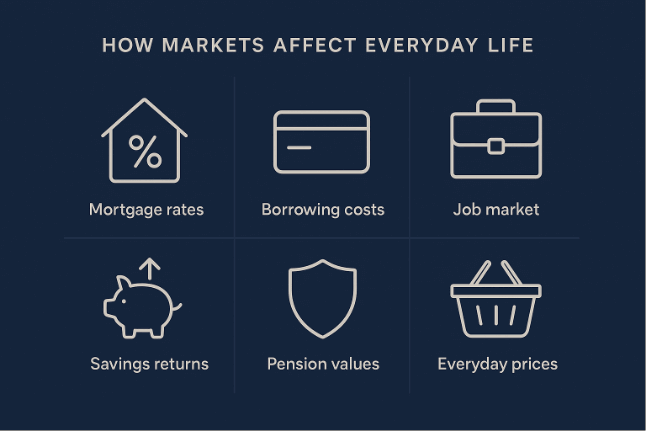
Financial markets may seem distant, but they shape many parts of everyday life. They influence the cost of borrowing, the value of savings, the strength of retirement accounts, and the stability of jobs and businesses. Markets help money flow to where it is needed most. Therefore, directing funds from savers to households, businesses, and governments that need capital. This allocation process supports the production of goods and services across the economy. [2][5]
Markets Influence Borrowing
Interest rates respond quickly to market conditions. When markets expect higher inflation or stronger growth, interest rates often rise. As a result, higher rates make mortgages, car loans, and credit cards more expensive. However, when markets expect slower growth, rates often fall, making borrowing cheaper. These shifts change how much people pay each month and how easily they can finance major purchases.
As borrowing costs move, savings and investments shift too.
Markets Shape The Value Of Savings and Investments
Savings accounts, CDs, retirement plans, and investment portfolios all move with the market. When markets rise, retirement balances and investment accounts often grow. Whereas, when markets fall, these balances may decline. Even people who do not actively invest feel the effects through pension funds, employer retirement plans, and insurance products tied to market performance.
Efficient markets also lower search and transaction costs. By offering a wide range of financial products with different risks, prices, and maturities, well‑developed markets help savers and borrowers find the right match for their needs. As a result, this makes long‑term saving and investing more accessible and more affordable.
These same forces shape how businesses operate.
Markets Affect Businesses And Jobs
Companies rely on financial markets to raise money, expand operations, and manage risks. When markets are strong, businesses can borrow more easily and invest in new projects. Therefore, supporting hiring, wage growth, and innovation. This flow of money helps companies bring new products to market, expand into new regions, and create jobs that support communities. However, when markets weaken, businesses may delay expansion or reduce spending. As a result, this can affect job opportunities and overall economic confidence.
Markets Support Public Services And Infrastructure
Governments also turn to financial markets to fund essential services. By issuing bonds, they can build new roads, schools, hospitals, and other public infrastructure. Hence, when markets function well, governments can borrow at lower costs, reducing the long‑term expense of these projects. Therefore, strong, stable markets support better public services and long‑term national investment.
These broad effects show up in everyday decisions as well.
Markets Guide Everyday Economic Decisions
Market signals help people and businesses make choices. Rising commodity prices can influence the cost of groceries, fuel, and household goods. Falling interest rates can encourage home buying or refinancing. Therefore, shifts in market expectations can affect how much people save, spend, or invest. These decisions add up and shape the broader economy.
Well functioning markets can even help lower everyday costs. For instance, when companies can borrow affordably and manage risks effectively, they can keep their costs down. So, the lower costs make it easier for businesses to offer lower prices to consumers, whether that’s food at the supermarket or the cost of a mortgage.
Markets Reflect And Shape Economic Confidence
Financial markets react quickly to changes in sentiment. When confidence rises, markets often strengthen. Yet, when uncertainty grows, markets may fall. These movements influence how people feel about the economy. Therefore, a strong market can boost optimism, while a sharp decline can make households and businesses more cautious. This feedback loop connects market behaviour to everyday financial choices.
And over time, these choices shape long term financial outcomes.
Markets Support Long‑term Financial Planning
Over time, financial markets help people build wealth. Retirement accounts, index funds, and diversified portfolios grow as companies expand and economies develop. In addition, well functioning markets make it easier to compare the cost of financing with expected returns. Therefore, helping investors make informed decisions. While short term movements can be unpredictable, long‑term market growth has historically supported long‑term financial goals. Understanding how financial markets work helps people make better decisions about saving for the future.
Glossary: Key Market Terms
- Market
- A market is a place where people buy and sell financial products such as shares, bonds, or currencies. Therefore, markets help match savers with borrowers and set prices based on supply and demand.
- Liquidity
- Liquidity describes how easily an asset can be bought or sold without affecting its price. Highly liquid markets allow people to trade quickly and at stable prices.
- Volatility
- Volatility measures how much prices move over time. When volatility is high, prices rise and fall more sharply as investors react to new information.
- Interest Rate
- An interest rate is the cost of borrowing money or the return earned on savings. As a result, changes in interest rates influence spending, investment, and overall market activity.
- Bond
- A bond is a loan made by an investor to a government or company. In return, the borrower pays interest and repays the amount borrowed at a set date.
- Equity
- Equity represents ownership in a company. Therefore, when people buy shares, they buy a small part of the business and may benefit if the company grows.
- Yield
- Yield is the income earned from an investment, usually shown as a percentage. Bond yields often rise or fall as market conditions change.
Conclusion
Financial markets influence far more than share prices. They shape borrowing costs, guide business investment, support public services, and help households save for the future. As a result, when markets function well, money flows to where it is needed most, supporting growth, stability, and long‑term prosperity. By understanding how markets work and why they matter, people can make more informed decisions about borrowing, saving, and investing.
Navigating both the opportunities and the risks that come with a changing economy means understanding how markets shift, why they move, and what those movements signal. Opportunities can appear when businesses grow, new industries emerge, or borrowing costs fall. Whereas, risks can rise when uncertainty increases, interest rates change, or global events disrupt supply chains. Therefore, by recognising how these forces interact, people can better understand the environment they’re operating in and make decisions with greater confidence.
FAQ How Financial Markets Work
Understanding How Markets Work
Financial markets work by actively connecting people who want to save with people who need to borrow or invest. Therefore, savers provide funds, and borrowers use those funds to build businesses, buy homes, or finance public projects. As new information appears, prices such as interest rates and share prices adjust. As a result, these price changes guide money toward the most productive uses and keep the economy moving.
No. The economy measures what people and businesses produce, earn, and spend. Whereas, financial markets react to what investors expect will happen next. Because markets respond to expectations, they often move before economic data changes. As a result, markets can rise or fall even when day to day economic conditions seem stable.
How Markets Affect Everyday Life
Yes. Markets influence interest rates, borrowing costs, job opportunities, and the prices of everyday goods. Therefore, even without owning shares or bonds, people feel market movements through mortgages, pensions, insurance products, and the overall strength of the economy. When markets move, they change the costs people face in everyday life.
Markets move because investors constantly reassess what they think will happen in the future. Therefore, even small pieces of information can change expectations about growth, inflation, or profits. At times, investors react to each other rather than to new data, which can create momentum in either direction. As expectations shift, prices adjust to reflect the new outlook.
Well functioning markets help money flow to where it can do the most good. As a result, they lower borrowing costs, reduce search and transaction costs, and make it easier for savers and borrowers to find financial products that fit their needs. Therefore, when markets operate smoothly, they support economic growth, strengthen financial stability, and help households and businesses plan for the future.
References and Further Reading
[1] Office of the Comptroller of the Currency. “Financial Markets”
[2] Bank of England. “What are financial markets and why are they important?”
[3] Congressional Research Service. “Resources for Financial Market Data”
[4] Office of the New York State Attorney General. “How financial markets work”
[5] Federal Reserve Bank of San Francisco. “Please explain how financial markets may affect economic performance.”
Recent Market Concepts Articles and Guides
-
How Diversification Reduces Risk in Investing
Diversification helps investors manage uncertainty by spreading exposure across different investments instead of depending on a single one to carry all the risk. This approach reduces the…
-
Risk vs Return: Understanding the Trade Off in Investing
Understanding risk vs return is one of the first steps in learning how investing works. Every investment offers the chance to earn a return. In addition, it…
Latest Free Market Concepts Tools You Can Download
-
Business Loan Affordability Calculator for Commercial and Industrial Property
This business loan affordability calculator is an Excel template that helps users test DSCR, compare repayments,…
-
Ratio Analysis Spreadsheet
A simple Excel spreadsheet that helps you calculate and understand key business financial ratios. Ideal for…
Online Calculators and Other Free Tools You Can Download
Explore these tools to run quick calculations, test ideas, and download resources that support your learning.
Disclaimer – Educational Use Only
Content on MoneyOpes.com is for informational and educational purposes only. It does not constitute financial, legal, or professional advice. Your financial situation is unique, and outcomes may differ. Past performance is not a guarantee of future results. MoneyOpes.com adheres to strict editorial integrity standards, and to the best of our knowledge, all content is accurate as of the date posted. See our full disclaimer.