
Estimated reading time: 7 minutes
Geopolitical conflict reshapes global markets. As a result, supply chains can break and governments redirect spending. Some investors move toward assets that rise during war as they search for stability. These war time assets often hold value or strengthen when uncertainty increases. Some assets can be bought directly. However, the stock market offers easier access through companies and ETFs tied to defence, energy, metals, and commodities. These shifts often shape how the stock market during war behaves as investors reposition toward sectors linked to conflict.
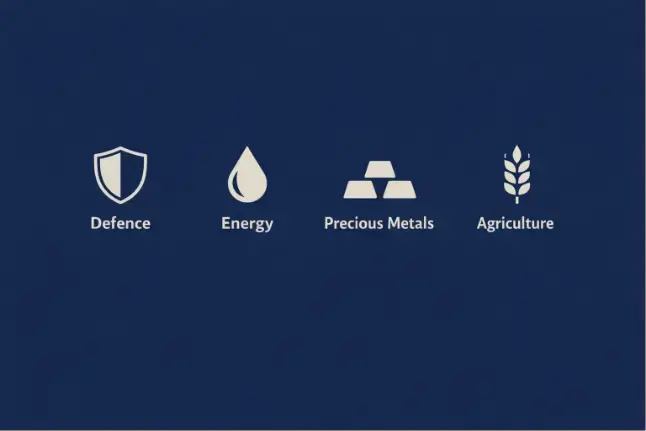
This guide outlines four assets that often strengthen during conflict. Moreover, show how investors access them through companies and ETFs on the stock market.
Table of contents
- 1. Defense Industry: A Core War Time Asset
- 2. Precious Metals: Classic Assets That Rise During War
- 3. Energy Markets: War Time Assets That Perform Well When Supply Is Disrupted
- 4. Commodities and Raw Materials: War Time Assets Linked to Global Supply Chains
- Final Note: The U.S. Dollar’s Pattern During Geopolitical Conflict
- The Market Votes in the Short Term, but Weighs in the Long Term
- Conclusion
- FAQs: Understanding the Stock Market During War
1. Defense Industry: A Core War Time Asset

Defense spending usually accelerates when conflict begins. Governments expand budgets for equipment, technology, cybersecurity, and intelligence systems. These shifts often lift demand for major defense contractors.
Examples of U.S. defense stocks include Lockheed Martin, Boeing, Northrop Grumman, RTX, and L3 Harris Technologies. These companies build aircraft, missile systems, satellites, and communication tools used in military operations.
Many investors prefer broad exposure instead of selecting individual companies. ETFs such as the iShares U.S. Aerospace and Defense ETF (ITA) and the Invesco Aerospace and Defense ETF (PPA) offer this. Vanguard does not offer a dedicated defense ETF. However, broader funds such as the Vanguard Industrials ETF (VIS) and the Vanguard Total Market Index include companies like Raytheon Technologies, Boeing, and Lockheed Martin.
These funds give investors broad exposure to companies that tend to benefit when defence budgets rise, a trend that often influences the stock market during war.
Learn more: Exchange Traded Funds (ETFs)
2. Precious Metals: Classic Assets That Rise During War

Gold and silver often attract demand during geopolitical stress. Investors view them as safe haven assets because they tend to hold purchasing power when currencies weaken. Gold is sometimes described as the ultimate insurance policy because governments cannot print it.
Ray Dalio highlighted this point on X after Moody’s downgraded U.S. sovereign debt from Aaa to Aa1 in May 2025, as reported by Moody’s Investors Service. He noted that credit ratings do not capture the risk of governments printing money to meet obligations, which can reduce the value of the currency that bondholders receive. [1]
Gold often holds value during inflation and conflict. Supporters argue that it is one of the few assets that is not a liability to someone else.
Stock market exposure includes gold mining companies, silver mining companies, and precious metal ETFs that hold miners or physical bullion. Mining stocks often move more sharply than the metals themselves, creating leveraged exposure to rising prices.
3. Energy Markets: War Time Assets That Perform Well When Supply Is Disrupted

Energy markets often react quickly to conflict. Wars disrupt oil and gas supply routes. At the same time, military operations increase fuel demand. These pressures can push energy prices higher.
Examples of energy companies include Chevron, BP, and Exxon Mobil. Energy producers, refiners, and pipeline operators often gain when oil and gas prices rise. Broader energy ETFs also offer diversified exposure to the sector.
Global supply disruptions are tracked by the International Energy Agency. In the Oil Market Report published 12 March 2026, it was noted that the current ongoing war in the Middle East is creating the largest supply disruption in the history of the global oil market. This is the as a result of crude and oil product flows through the Strait of Hormuz plunging from around 20 mb/d before the war to a trickle currently. [2]
4. Commodities and Raw Materials: War Time Assets Linked to Global Supply Chains
Conflict often disrupts the flow of metals, grains, and other raw materials. When supply chains break, shortages can push prices higher.
Examples of stock based exposure include mining companies, agricultural producers, and commodity focused ETFs. These companies extract, process, or transport materials that become more valuable when supply tightens.
Final Note: The U.S. Dollar’s Pattern During Geopolitical Conflict
The U.S. dollar often strengthens during global instability. Investors seek liquidity and security, and the dollar remains the world’s reserve currency. While you cannot buy the dollar directly through the stock market, companies with large U.S. revenue streams or dollar denominated assets can benefit from a stronger currency.
These shifts across defence, metals, energy, and commodities help explain why the stock market during war can behave differently from normal economic cycles.
The Market Votes in the Short Term, but Weighs in the Long Term
Markets often move sharply during conflict. Prices react to headlines, fear, and fast changing expectations. This is the short term voting machine at work, where sentiment drives most of the movement.
As time passes, emotional swings fade and fundamentals take over. The market shifts back to weighing the strength of real businesses. Revenue, profits, cash flow, and competitive advantages start to matter more than headlines. Warren Buffett has repeated this idea for decades. He often quotes a line he attributes loosely to the teachings of Benjamin Graham, his mentor:
“In the short run, the stock market is a voting machine. But in the long run, it is a weighing machine.” [3]
Buffett uses this idea to show how markets eventually judge companies by their underlying quality rather than short term noise. Strong businesses with durable advantages, healthy balance sheets, and steady demand tend to stand out once the weighing begins. Even when assets that rise during war attract attention, long term results still depend on business fundamentals.
Readers who want to understand how to evaluate business quality and estimate fair value can explore the guide on valuing stocks.
Conclusion
Conflict changes how markets behave. Some assets hold value or strengthen when uncertainty rises, especially those tied to defence, energy, precious metals, and global supply chains. Investors can access these areas directly or through the stock market using companies and ETFs linked to each sector. While these assets often attract attention during war, long‑term results still depend on business fundamentals. Strong companies with durable advantages tend to stand out once markets shift from reacting to headlines to weighing real performance.
Quick Summary: Assets That Often Rise During War – Accessing them via the Stock Market
- Defence — companies supplying equipment, technology, and cybersecurity.
- Energy — oil and gas producers, refiners, and pipeline operators.
- Precious metals — gold and silver, plus mining companies and metal‑focused ETFs.
- Commodities and raw materials — miners, agricultural producers, and commodity‑linked ETFs.
FAQs: Understanding the Stock Market During War
The stock market during war often becomes more volatile as investors react to headlines and uncertainty. Some sectors weaken when supply chains break or consumer demand slows. Others strengthen, especially defence, energy, precious metals, and commodity‑linked companies. These shifts reflect how capital moves toward assets that hold value when risk increases.
Defence companies, energy producers, precious metals, and raw materials often attract demand during conflict. These assets can benefit from higher government spending, supply disruptions, or safe haven flows. Investors can access them through individual stocks or ETFs that track each sector.
Investing in the stock market during war carries higher uncertainty. Prices can move sharply in the short term as markets react to new information. Long term results still depend on business fundamentals such as revenue, profits, and competitive strength. Diversified ETFs and broad market funds can help reduce single company risk during volatile periods.
References and Further Reading
[1] Ray Dalio. “Ray Dalio — X post on U.S. debt downgrade (20 May 2025)“
[2] International Energy Agency (IEA). “Oil Market Report – March 2026”
[3] The Economic Times. Market quote of the day by Benjamin Graham
Recent Articles on Stocks
-

Investing in Stocks: A Beginner’s Guide to How Stocks Work
Investing in stocks is a common way to grow wealth…
-

How a USD Decline Could Affect US Stocks and International Markets
The value of the United States dollar influences trade, earnings,…
-

Ways to Value a Stock: Main Approaches, Value Investing, and a Coca‑Cola Case Study
Valuing a stock starts with a simple idea. You want…
-

Bottom -Up and Top-Down Approaches to Picking Stocks
Investors use different ways to study the stock market. Many…
-

Wide Moat Companies. How They Win Over Time and How to Spot Them
Wide moat companies often hold strong positions that last. This…
-
Choosing a Stock Broker: Find One That Fits Your Investing Style
Choosing a stock broker is an important step in your…
Explore More Stocks and Investing Resources And Tools
Use calculators and downloadable tools, such as our ratio analysis spreadsheet to apply what you learn.
Disclaimer – Educational Use Only
Content on MoneyOpes.com is for informational and educational purposes only. It does not constitute financial, legal, or professional advice. Your financial situation is unique, and outcomes may differ. Past performance is not a guarantee of future results. MoneyOpes.com adheres to strict editorial integrity standards, and to the best of our knowledge, all content is accurate as of the date posted. See our full disclaimer.